Skip to content

Disability Inclusion: Actions for Change
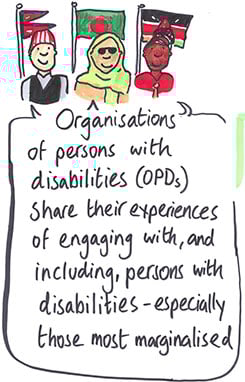
The poster is introduced with the foundational statement: 'Organisations of Person with Disabilities (OPDs) shared their experiences of engaging with, and including, persons with disabilities - especially those most marginalised.' The OPDs were from Bangladesh, Pakistan and Kenya. This poster represents what they had to say.

Foundations for Change

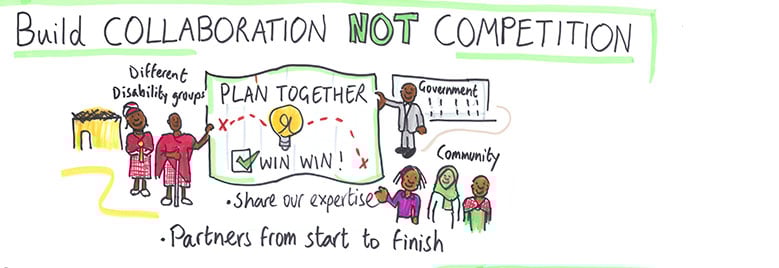
Build COLLABORATION NOT COMPETITION: This section shows: Illustrations of diverse people from different disability groups, holding a large map. The large map contains a lightbulb symbol representing the need to 'PLAN TOGETHER.' A Ticked box showing 'WIN WIN!' approach works best for all. Figures representing Government and Community working together Key messages: 'Share our expertise' and 'Partners from start to finish.'
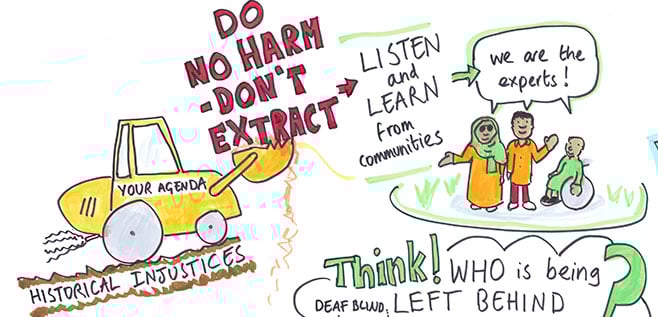
DO NO HARM - DON'T EXTRACT: This section warns against extractive practices showing: A bulldozer labelled 'YOUR AGENDA' crushing the words 'HISTORICAL INJUSTICES.' Words emphasizing the need to DO NO HARM and to 'LISTEN and LEARN from communities.' Speech bubble states 'we are the experts!' highlighting that persons with disabilities are experts on their own experiences Think! Who is being LEFT BEHIND?: A thought bubble lists often-excluded groups: DEAF BLIND. HEARING / SEEING. intellectual disabilities. PSYCHOSOCIAL disabilities. This reminds practitioners to actively consider who might be excluded from programs.
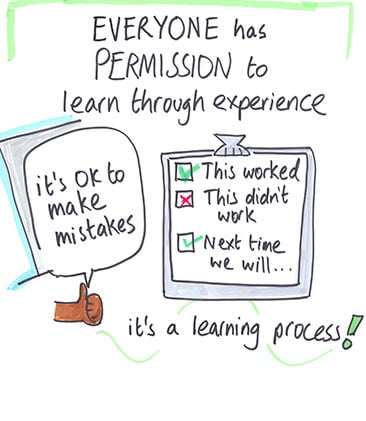
EVERYONE has PERMISSION to learn through experience: This section normalizes mistakes as part of learning, showing: a clipboard with ticked boxes: 'This worked', 'This didn't work', 'Next time we will...' Speech bubble saying 'it's OK to make mistakes' with a thumbs up illustration. Emphasizing 'it's a learning process!' Including a thumbs up illustration

Design for Change

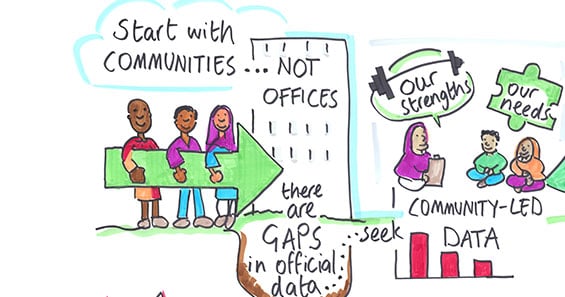
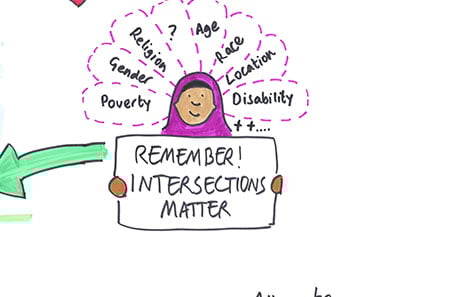
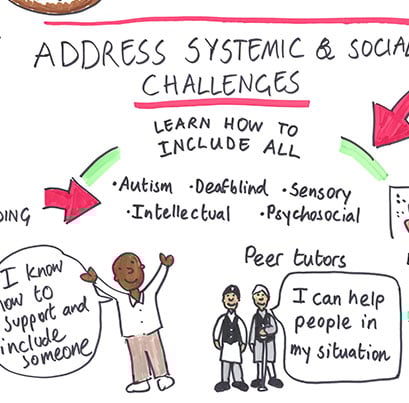
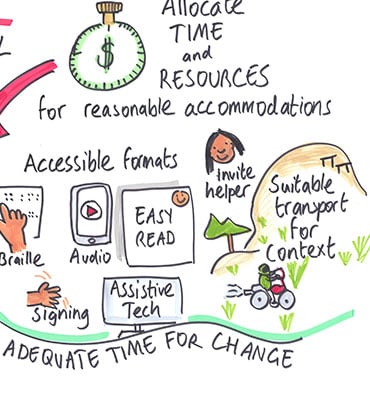
Starting Point - Community First: The illustration emphasises starting with communities rather than offices. It shows three diverse individuals holding an arrow which is pointing to a building, representing offices. The message highlights that there are gaps in official data, and encourages seeking community-led data instead. Illustrations show people discussing 'our strengths' and 'local needs' with bar charts representing data collection. Intersectionality: A woman wearing a hijab is surrounded by overlapping circles representing different identity factors: Age, Race, Gender, Education, Poverty, and Disability. The woman is holding a text box which emphasises 'REMEMBER! INTERSECTIONS MATTER' - highlighting that people experience multiple, overlapping forms of discrimination and identity. Address Systemic and Social Challenges: This section is divided into two main areas. Left side - Barriers: Shows a jagged-edged shape labelled 'non-inclusive Societal norms.' Lists key barriers: STIGMA, ISOLATION, LACK OF UNDERSTANDING. Illustrates a person in a wheelchair, representing excluded individuals. Mentions POLICY CHANGE as necessary Centre - Learning Inclusion: Text states 'LEARN HOW TO INCLUDE ALL.' Lists different disability types: Autism, Intellectual, Deaf and blind, Psychosocial, Sensory. Shows a man saying 'I know how to support and include someone.' Next to him are two peer tutors. One of these is a Nepali man with a visual impairment and his helper. Both are wearing traditional Nepali dress. The person with a visual impairment is saying 'I can help people in my situation.' Right side - Solutions: A curved arrow points to practical accommodations: 'Allocate TIME and RESOURCES for reasonable accommodations.' Shows 'Accessible formats' including: Braille, Audio, Easy read, Signing, Assistive Tech. Illustrations show: invite helper, provide suitable transport for context, such as motorbike for rural areas. Emphasises the need to allow 'ADEQUATE TIME FOR CHANGE.'

Implement Change

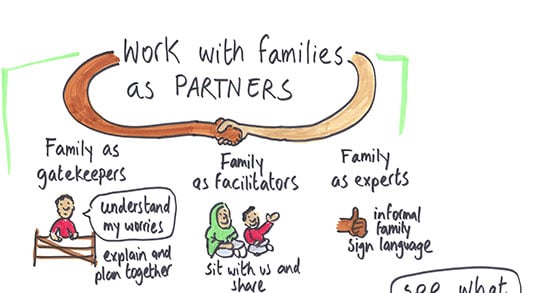
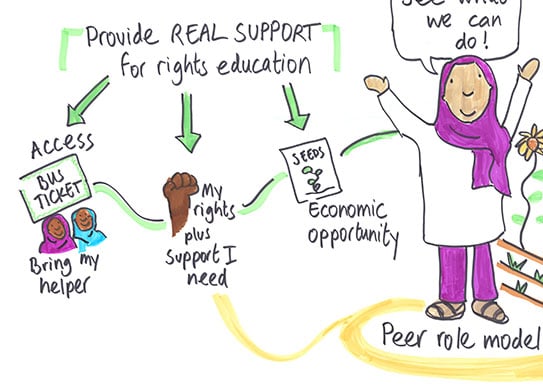
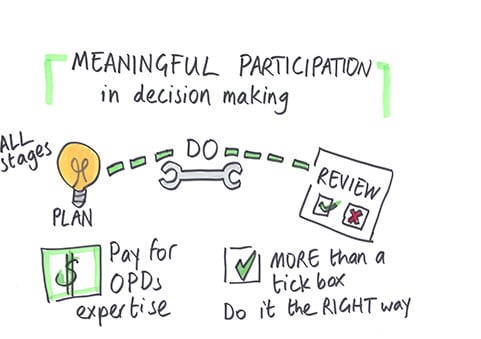
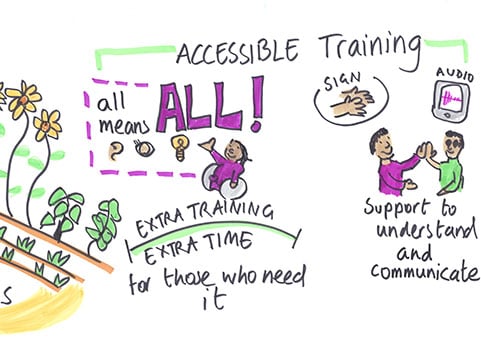
Work with families as PARTNERS: This section shows three different family roles, illustrated with a curved handshake symbol: Family as gatekeepers: Figure standing behind a gate with speech bubbles: 'understand my worries' and 'explain and plan together.' Family as facilitators: Figures sitting together: 'sit with us and share.' Family as experts: Shows use of 'informal family sign language.' Provide REAL SUPPORT for rights education: Three connected areas show types of support: Importance of ACCESS, with the words 'bus ticket' and 'Bring my helper' around two people. Rights education: the words 'My rights plus SUPPORT I need.' Economic opportunity: Shows packet of 'SEEDS' and 'Economic opportunity.' Peer role models: Central illustration shows a person in hijab with raised arms in celebration, with flowers around them, representing empowerment through peer support and role modelling. MEANINGFUL PARTICIPATION in decision making: Shows the full cycle of engagement: 'ALL stages' with lightbulb icon: PLAN then DO then REVIEW (with checkmarks and X marks for evaluation). 'Pay for OPDs expertise.' Text emphasises: 'MORE than a tick box - Do it the RIGHT way' ACCESSIBLE TRAINING: Large highlighted section stating 'all means ALL!' Shows inclusion of SIGN and AUDIO accessibility. Emphasises 'EXTRA TRAINING EXTRA TIME for those who need it.' Illustrations show people using sign language. Text notes importance of support to 'understand and communicate.'
Partner organization logos: CBM Global Disability Inclusion logo, Blind Youth Association Nepal logo, NGDO (National Grassroots Disability Organization), and NONDO.