For the last five years CBM has been involved in both the annual global UNFCCC COP climate change conferences as well the intersessional preparatory meetings which take place halfway through the year in Bonn. This June, CBM UK joined government representatives and other civil society organisations, including disability activists, to participate in technical workshops on Action for Climate Empowerment (ACE), and contribute disability inclusion perspectives.
Disability inclusive climate action is better climate action
Posted on:
Wednesday, July 15th, 2026
Author:
Ursula Grant
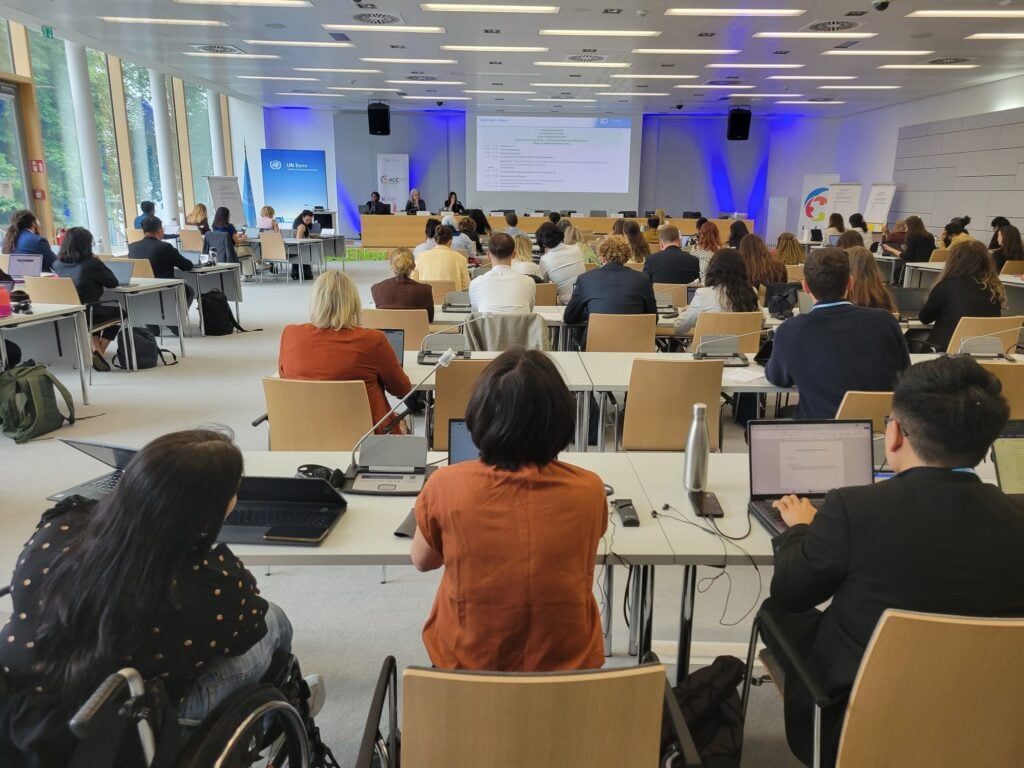
ACE was one of many different streams of discussions and negotiations, ranging from Just Transition to the Global Goal on Adaptation – all trying to deliver action and results on climate action. The ACE workshops were reviewing the progress since Glasgow 2021 when this work programme was first adopted. Participants reflected on lessons learned from the current ACE action plan and explored priorities for a future programme that can better support inclusive, effective and equitable climate action.
ACE as a cross-cutting enabler of effective climate action
One of the strongest messages was that ACE cuts across many UNFCCC work and climate action programmes and should not be considered a standalone workstream. ACE is often solely associated with climate education, but it is much broader than that. Its six pillars cover climate education, training, public awareness, public participation, public access to information and international cooperation.
Accordingly, ACE provides a framework for enabling people to engage in and drive climate action. It therefore needs to better connect with every other climate process, including adaptation and mitigation planning, just transition efforts and broader climate justice agendas.
Make disability inclusion a requirement, not an option
Disability inclusion featured more prominently in the ACE conversations than in previous workshops, with Rosa Maria Juare Cobenas from RIADIS (the Latin American Network of Organisations of Persons with Disabilities and their Families) giving a keynote address. Contributors to the workshop from disability organisations and allies, including us, emphasised that people with disabilities are often among those excluded from the systems that ACE seeks to strengthen.
We argued that accessibility should be a requirement, not just a recommendation. Universal design and accessibility must be embedded from the outset of any ACE initiative, from awareness campaigns to public consultations, learning initiatives and international meetings.
Important issues were raised including the need for accessible information in formats such as sign language and Easy Read, more accessible digital platforms, and much greater recognition of Organisations of Persons with Disabilities (OPDs) as leaders and partners in climate action. We discussed the “hidden costs” of participation and that meaningful inclusion requires dedicated resources that are planned from the outset.
As one participant noted, “without budget allocations, inclusion remains an aspiration rather than a reality”.
Ensuring impact not just activity
Demonstrating impact rather than simply counting activities is vital. Participants called for improved monitoring, evaluation and reporting systems that capture changes in knowledge, attitudes, behaviours and participation. There was strong support for collecting and reporting disability-, age- and gender-disaggregated data to better understand who benefits from ACE initiatives and who is left behind.
Greater support, capacity building and coordination is needed across government ministries and stakeholders led by ACE country focal points, who play a crucial role in ensuring impact. For disability advocates, this is about engaging in international climate spaces as well as with national ACE focal points and networks.
Next steps towards COP31
The final draft text from the technical workshops will now be negotiated on at COP31. It includes references to disability but with many currently in brackets and so need to be agreed upon. CBM UK will be there to continue to push parties to ensure this language remains and not cut.
Alongside the Disability Caucus we will be making a formal submission as we prepare for COP31, and use the conversations had in Bonn to highlight the need to strengthen a rights-based approach to ACE. We would call on all parties, constituencies and observers to support the disability movement in making the case for disability inclusive language to be added and remain in the workplan in their submissions too.
Whilst there is growing recognition of people with disabilities as active partners and leaders in climate action, Türkiye presents an important opportunity to continue working with governments to ensure disability inclusion is fully embedded in ACE and climate empowerment reaches everyone.
Resourcing inclusion is fundamental to effective climate action
A final takeaway was that ACE is valuable not only in its own right, but when drawn upon can help create better climate policies and processes. When people are well-informed, participation is inclusive, information is accessible, and diverse voices are genuinely engaged, climate decisions are likely to be more effective, equitable and sustainable. Although challenges remain, it was encouraging to see growing recognition that disability inclusion must be part of how climate empowerment is understood and implemented.
More news like this
September 29, 2026
What is COP31 and why does it matter for people with disabilities?
As we approach COP31 this year in Türkiye, CBM UK reflects on what COP is, why it’s important, and what it means for people with disabilities across the world.
September 22, 2026
Strengthening disability inclusion with CAFOD
Kirsty Smith, CEO of CBM UK, reflects on our two-year partnership with CAFOD to strengthen disability inclusion across its Nigeria programme and wider global work.
August 4, 2026
Putting people at the heart of change: Andy Burnham’s chance to rewrite Britain’s international development legacy
In 2024 Labour promised a world free from poverty on a liveable planet.